
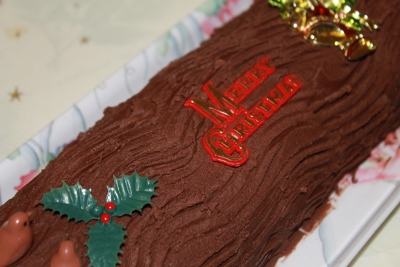
This is every bit as delicious as the original (indeed, the original swiss roll is fat free in the first place). The icing is the adjusted part.
You must be organised to make a good swiss roll. Don’t start this recipe without reading it all the way through first. You must have everything you need on hand and within reach before you start, as this is a recipe which has to go quickly once you have started.
For this recipe you will need a swiss roll tin, two large mixing bowls, a pyrex glass dish, an electric hand mixer (by hand is feasible but very hard work), an old newspaper, some silicone baking paper, a wire cooling rack, a rectangular cake board and a mug of boiling water.
The keys to success with this cake are to do the beating hard and everything else gently! Although the list of instructions below seems formidable, it’s much easier than it sounds.
Recipe: Chocolate Log
Summary: Traditional chocolate Swiss Roll
Ingredients
For the cake
- 3 medium eggs
- 4oz / 110g caster sugar
- 2oz / 50g sifted self-raising flour
- 0.5oz / 10g cocoa powder
- a little flavourless vegetable oil
For the icing
- 8oz / 225g icing sugar
- 3.5 oz / 85g softened Tomor
- 3tbsps sweetened soya milk
- a couple of drops of vanilla extract (not essence, tastes bitter)
- about 1oz / 25g sifted cocoa powder
Instructions
- Remove the Tomor from the fridge several hours before you wish to cook so that it is soft enough to use for the icing. If you have forgotten, you can heat the desired quantity in the microwave for a few seconds, but do remember to put it in a dish of some sort rather than on a plate (melted Tomor can go everywhere) and zap it only in very small amounts at a time as you don’t want it liquid!
- Pre-heat the oven to Gas Mark 7 / 220°C / 400°F.
- Grease a swiss roll tin with a little flavourless vegetable oil and line it with silicone baking paper.
- Sieve the flour and cocoa powder together.
- Put the sugar in a pyrex glass dish and heat it in the oven for about 2 minutes.
- Meanwhile, break the eggs into a large mixing bowl and beat with mixer on high speed.
- Add the hot sugar while the mixer is still going and beat the mixture until it has doubled in size and is pale and fluffy.
- Gently fold in the flour/cocoa mixture using a metal spatula or spoon.
- Pour the cake mixture into the prepared tin and spread it out gently until it is evenly distributed.
- Bake on the middle shelf of the oven for about 8 minutes. Do not open the oven in less than 7 minutes. When you do open the door do so gently and keep it open only wide enough to reach in without burning yourself. Test the cake lightly with your fingertips and, if it is not quite ready, shut the door as gently as possible. When it is ready the cake should just be very slightly springy to the touch and should be just starting to come away from the sides.
- While the cake is in the oven, you need to clear yourself a patch of table/worktop for the rolling process. You also need to make up the icing.
- Put the softened Tomor in a large mixing bowl and beat it either with a wooden spoon or with an electric mixer on medium speed until the Tomor is light and fluffy. Gradually add the icing sugar. I add a small amount of soya milk at this stage to start the icing sugar off, but you don’t have to. With the hand mixer on slow, blend the ingredients together, adding the soya milk a little at a time until the consistency is right. Icing is a tricky creature to get to grips with. No matter how carefully I measure things out it always comes down to adding a bit more sugar and then a bit more soya milk until I have the consistency I want, so be prepared to fiddle around with this stage.
- When the icing is smoothly blended, beat in the vanilla essence, then put about a third of it into a second mixing bowl. This will form the filling for the log. You want it a little softer than you would for icing to coat a cake, so add a little more soya milk at this stage. Aim for a consistency that will stretch smoothly off a spoon when you lift up a dollop, but is not runny. If you have this too thick, it will never spread over your swiss roll and you will tear up the surface of the cake as you attempt to cover it.
- The remaining two thirds of the icing is for the outside, so you need to add the cocoa powder to it. This should be done by sieving the cocoa, as cocoa powder always has lumps and they won’t just beat out. Push the cocoa through the sieve with a spoon rather than shaking it or you’ll end up with a fine layer of cocoa all over the kitchen. Remember that from the moment you add the cocoa, the more you beat it the paler it will go. To avoid having a pale beige log, add a little soya milk to the mixture before you add the cocoa. When the milk is blended in and the mixture has softened just a bit, start adding the cocoa. Keep adding cocoa until the icing is the colour you would like and beat it just enough to make the colour even throughout.
- When the cake is ready to come out of the oven, spread out the old newspaper, full thickness, on the table. On top of that, lay a sheet of baking paper which is about 8″ / 20cm longer than your swiss roll tin and at least as wide as it. Put the cake still in its tin onto the cooling rack and leave to cool for about 5 minutes.
- This is the first tricky bit. You need to put the cake upside down onto the baking paper. You also want to position it so that at least 4″ / 10cm of one of the narrow ends of the baking paper is left free: you’re going to need to hold on to this bit. It sounds impossible, but I’ve never yet managed to drop one even though I keep thinking I’m going to! Holding the tin with a cloth, as it will still be a bit too warm for bare hands, position it along one of its long sides on the baking paper strip. Slide your hand in the cloth under the tin until it is in about the middle of the tin’s base and flip it down on its face onto the paper.
- While you are congratulating yourself on achieving this feat, lift off the tin, carefully peel off the baking paper from the bottom of the cake and allow it to cool for a couple of minutes. You do not want the cake to be completely cool before the next bit as it rolls more easily while it is still slightly flexible.
- Trim just a sliver of cake off each of the long sides (this is to remove any crispy bits which make rolling the cake a real challenge) and put on the filling icing. I use a spoon for dolloping the icing and a knife dipped in a mug of boiling water to spread it out. Put small dollops of icing all over the cake and spread them out very gently. If you are rough with this stage you will end up with a ploughed field effect, so take care. Beware of being over-generous with the icing or the cake won’t roll: try to keep to a limit of about ¼” / 5mm.
- Have the bowl containing the covering icing within easy reach of where you are going to roll the cake, along with a knife and a fork standing in a mug of hot water. You will also need to have the cake board ready and within reach.
- Now for the second tricky bit. You need to have faith with this. Line up the cake so that the narrow end with the extra greaseproof paper is facing you. Gently ease up the end of the cake closest to you and crease it in to start the roll. Next catch hold of the end of the greaseproof paper closest to you. You will need to scrunch the paper up in your hands a bit to keep some tension on the cake. Keeping both of your hands moving at the same speed, slowly but steadily tow the paper over the cake away from you. The cake should roll up like magic.
- If disaster strikes and it cracks or splits, don’t panic, just hold it together on the paper with one hand (and forearm sometimes!) and with the other hand use the greaseproof paper as a sling to lift the cake onto its board. Keep hold of the cake and use the covering icing to “glue” it together! Incredibly, you can end up with a respectable log even after an apparent disaster.
- When you have the cake covered in icing, make sure that you have sealed it to the board as this ensures that the cake will stay fresh over the Christmas period. Using the heated fork, make bark patterns along the log, not forgetting to include the occasional “knot” in the decoration.
Variations
This recipe works just as well with 81% Stone Ground self-raising flour, but you need to add a mountainously heaped teaspoon of baking powder to the flour/cocoa mixture to make it rise and a tablespoon of water to the eggs to compensate for the extra absorbency of the flour.
Preparation time (duration): 60 minutes
Cooking time (duration): 8 minutes
Diet type: dairy free
Number of servings (yield): 12
Meal type: dessert
Microformatting by hRecipe.
Hello,
I know this isn’t the right place to post my comment but I’m not sure where the right place is! Anyway, my son is severely milk-protein allergic and so over the last three years I have been experimenting with various dairy free recipes. Last week I finally perfected a cream-cheese style topping for a carrot cake (which is also dairy free but not my recipe – it’s Delia Smith’s). It’s been taste-tested by various dairy-free and dairy-eaters and no-one could tell the difference. I was wondering if there is any way of posting recipes?
Thanks,
Helen
Hello
Just looked at this recipie and I am defiantly using it for christmas. Thanks for your help.
Christina