
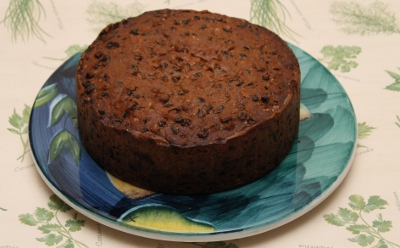
All ready for decorating
My mother has been making this cake for Christmas and special occasions in the family for about thirty years. It is truly delicious: moist but not sticky. It isn’t cheap because of all the fruit, but it is well worth the effort for a traditional Christmas cake. Do note that the cake is best made a month or so before you eat it.
Recipe: Traditional Fruit Cake
Summary: A moist and luxurious fruit cake, suitable as a Christmas or wedding cake
Ingredients
| Round 8″ | Round 9″ | Round 10″ | ||
|---|---|---|---|---|
| Square 7″ | Square 8″ | Square 9″ | ||
| Currants | 14 oz / 400g | 1lb 2oz / 500g | 1lb 6oz / 625g | soak overnight in a good slosh of rum or brandy |
| Sultanas | 7oz / 200g | 9oz / 250g | 12oz / 350g | |
| Raisins | 7oz / 200g | 9oz / 250g | 12oz / 350g | |
| Plain flour | 9oz / 250g | 11oz / 315g | 14oz / 400g | |
| Flaked almonds | 1½oz / 35g | 2½oz / 60g | 3oz / 75g | mince together |
| Citrus peel | 1½oz/35g | 2½oz/60g | 3oz/75g | |
| Mixed spice | ½ level tsp | ¾ level tsp | 1 scant tsp | |
| Glacé cherries | 3oz / 75g | 3½oz / 85g | 5oz / 150g | |
| Eggs | 3 large | 4 large | 5 large | |
| Dairy-free spread | 7oz / 200g | 9oz / 250g | 12oz / 350g | |
| Soft dark brown sugar | 7oz / 200g | 9oz / 250g | 12 oz / 350g | |
| Lemon (grated rind and juice) | 1 | 1 | 1 | |
| Sherry, rum or brandy(optional) | 2 tbsps | 2½ tbsps | 3 tbsps |
Method
Instructions
- Soak the dried fruit overnight in a good slosh of brandy or rum. This makes a big difference to the final texture of the cake. The alcohol will all cook off, so if you don’t want alcohol in the finished cake, don’t worry.
- Preheat the oven to Gas Mark 6 / 200°C / 400°F
- Grease a cake tin with dairy-free spread and line it with two layers of greaseproof paper. Grease the paper lining as well. Cut a strip of brown paper or newspaper 2″ / 5cm higher than the depth of the tin and about 2″ / 5cm longer than the circumference of the tin. Fold the strip in half lengthwise, wrap it around the tin and secure with string. N.B. Do not use Sellotape or plastic string: they melt. You need proper, old-fashioned string.
- Mince together the almonds, peel and cherries. An old-fashioned mincer seems to work best, but a food processor with a small container would do. The aim is to end up with a finely chopped/mashed mixture.
- Sift the flour and mixed spice together in a bowl.
- Beat the eggs in another bowl.
- Cream the dairy-free spread and sugar together in a large bowl until the mixture is light and fluffy.
- Add the beaten eggs to the spread and sugar mixture a little at a time. With each addition of egg add a small amount of your flour and spice mixture: roughly a dessertspoonful is plenty. The flour will stop the mixture from curdling. Beat well after each addition.
- Add the lemon rind and stir well.
- Add the dried fruit and the almond/peel/cherry mixture. Mix very thoroughly.
- Stir in the flour/mixed spice and add the lemon juice. Mix well again.
- Scoop into the tin, pressing down gently with a spoon to ensure there are no air pockets. Level the top with the back of the spoon.
- Line a baking tray with two layers of brown paper/newspaper and place the filled cake tin on it.
- Reduce the oven temperature to Gas Mark 3 / 170°C / 325°F
- Bake the cake on one shelf below the centre of the oven for:
- 1st hour – Gas Mark 3 / 170°C / 325°F
- 2nd hour – Gas Mark 2 / 150°C / 300°F
- 3rd hour – Gas Mark 1 / 140°C / 275°F
- 4th hour – Gas Mark ½ / 120°C / 250°F
- If the cake is still very pale after 3 hours, cook for the fourth hour at Gas Mark 1 / 140°C / 275°F. If after 3 hours the cake is already sufficiently brown but not fully cooked, put a sheet of brown paper over the top for the fourth hour. Otherwise leave uncovered and lower the temperature as per the instructions. After 3 hours test cake every 30 minutes to see if it is cooked. Test by pressing gently with your fingers: if it is cooked, it should spring back when pressed and it will have started to shrink in slightly from the sides.
- When the cake is cooked, remove it from the oven but leave it in the tin to cool.
- When it is completely cool, remove it from the tin. To make the cake keep well and stay moist, you may wish to prick over the top with a skewer and spoon a little sherry, brandy or rum into the cake. Turn the cake upside down and repeat the process. Wrap the cake in foil and store in an airtight tin. For the full effect, the pricking and dosing with spirits should be repeated twice more at intervals of a week.
- Before serving, we usually just cover with a thick layer of marzipan. You could go the whole hog and cover with marzipan and royal icing if you wanted…
Variations
This recipe works just as well if made with 81% Stone Ground Self Raising flour. The extra “oomph” of the self raising flour compensates for the increased heaviness of the bran content, and the taste and texture are really good. Most good health food shops sell Marriages 81% flour (not Holland and Barratt in my experience), though it is rare in supermarkets. You can use 100% Stone Ground flour, but you must expect a much heavier texture. You would also probably need to increase the liquid levels in the recipe to compensate for the extra absorbency of the high bran content. I know that 81% flour works perfectly to the original recipe because I’ve done it!
Preparation time (duration): 90 minutes
Cooking time (duration): 3 – 4 hours
Diet type: dairy free
Number of servings (yield): 20
Meal type: dessert
Microformatting by hRecipe.
I must try this one. Fruit cake with no dairy products sound very interesting.
I’ve just discovered your fruit cake recipe and it looks like a delicious challenge. I may volunteer my husband to take part in the preparation. Being severely lactose-intolerant and a fruitcake lover, I’m pleased that this should be a dynamite cake. For the
slosh of alcohol I may try one of the fruit-flavored brandies such as orange. I’m assuming that the citrus peel is in dried form. Also, I wonder if using a tube cake pan would be okay? Happy holidays to you and if you are able to reply I would be so appreciative.
Sue
Hi Sue,
I’m delighted you’re going to have a go at this recipe. It’s not that hard to do…just a bit time consuming in the preparation stage. The citrus peel is the dried glace sort. I should think the fruit-flavoured brandy would be lovely. When it comes to the tin, I’d be a bit careful on the timing if your tin is hollow in the middle, as the heat will get at the middle of the cake-mix faster than it would in a conventional tin. This will cook it faster than usual and I would hate you to end up with a dry cake. It will take at least a couple of hours I would think, and you shouldn’t open the door for a while at least to avoid the risk of it sinking in the middle. I’ve never used a tin that shape for a fruit cake. They work well for madeira, but that’s easier to judge because the cooking time is so much less than a fruit cake. Do let us know how you get on.
Best of luck!
Sian
Hi Sue,
This email looks great. my Dad is lactose intolerant and I want to make this cake for him. I was wondering, can I use olive oil or canola oil instead of dairy free spread?
Thanks, Victoria
Bother, sorry, I meant to say recipe, not email!
Hi Victoria,
I’ve never tried using oil instead of a solid butter substitute. I’m not sure how successful it would be, since you start by creaming the “butter” and sugar together, which is impossible with oil. You can buy dairy-free spreads like Pure and Vitamite from most large supermarkets now, so it’s not hard to get hold of. Alternatively, if you have a Jewish deli near you, Tomor is a hard dairy-free margarine which works well. (Makes lovely pastry too!)
However you end up making it, do let us know how you get on. Thanks for dropping by. I hope you find some recipes you can use and enjoy.
Regards,
Sian
Thanks very much. I don’t live in the UK but in Africa. There’s no Pure here and I haven’t been able to find a margarine that doesn’t contain citric acid, another thing my Dad can’t eat. But, my family are coming for Christmas so perhaps I’ll ask them to bring some Pure with them! If not, I’ll try using oil. Thanks again, Victoria
Ah, well that would make things more complicated. If you can get hold of a hard vegetable margarine, that would cream with sugar. The flavour won’t be quite as rich as if you were using butter, but at least it wouldn’t make your Dad ill!
Just wanted to leave a thank you for the recipe. I am a lactose intolerant veggie so usually follow vegan recipes for cakes. However, I don’t mind using well sourced eggs and was happy to do so for my first solo Christmas cake (having previously baked one under my Mum’s watchful eye).
I used Flora Freedom which is currently the easiest non-dairy spread for me to get hold of.
The only adjustment I made was to use scotch as my tipple of choice. I gave it three doses – a fourth (and even a fifth) would have been amazing but the cake was delicious and my family really enjoyed it (no questions about whether it was dairy free).
🙂
Congratulations! I’m so glad your family enjoyed your first foray into solo Christmas cake baking. It’s usually a good sign when nobody asks whether or not it’s dairy-free. It does indeed work just as well with scotch – it’s all a question of personal taste (and what happens to be in the cupboard!). We’re using Flora Freedom for most things now as well. It’s easy to find, tastes pleasant and makes much better “butter” icing than some other dairy-free spreads.
Happy Christmas and happy baking!
Sian